Skip to Content or Footer

From Design to Delivery: Where Fit-Out Projects Can Go Wrong

Fit-out projects bring together multiple teams, suppliers and services. We explore where problems can arise when these aren’t properly coordinated, and how a joined-up approach can help from design through to handover.

Creating a Stronger Identity at Student Castle York

A fit-out project can involve dozens of different companies, suppliers and specialists before a finished space is finally handed over.

There may be an interior design team developing the scheme, contractors delivering the works, manufacturers producing bespoke items, suppliers providing furniture and equipment, and teams preparing the building for occupation.

Each has an important role to play. But often, it is the gaps between those roles where problems begin.

A late specification change affects procurement. A product with a long lead time holds up installation. Something that worked on a drawing doesn’t quite work on site. A delay to one part of the programme has a knock-on effect on several others.

So where do fit-out projects commonly run into problems – and could a more joined-up approach make them easier to deliver?

Clarence dock leeds

Where Design and Delivery Can Become Disconnected

There is a big difference between designing a space and physically delivering it.

A scheme may work well visually, but the team responsible for delivering it also needs to consider buildability, existing services, access, materials, lead times, installation and budget.

When those conversations happen early, potential issues can often be identified while there is still time to address them.

When they happen once work is already underway, the options can become much more limited. Changes at that stage can affect cost, procurement and programme, while substitutions made under pressure can move the finished space away from the original design intent.

Bringing design and delivery teams together earlier can help practical considerations become part of the design process rather than problems to solve later.

Student Castle York Inspired Projects MoonBoard Redesign

The Impact of Late Procurement on Project Delivery

Procurement can have a much bigger influence on a programme than it might initially appear.

A large development could require hundreds of beds, mattresses, desks, chairs, appliances and other items. All of these need to be specified, ordered, manufactured or sourced, delivered and, in many cases, installed at the right point in the programme.

If procurement begins too late, lead times and availability can start dictating decisions.

Products may need to be substituted, deliveries can clash with other work taking place on site, and teams can find themselves looking for alternatives when the programme is already under pressure.

Considering procurement earlier means quantities, budgets, availability, lead times and delivery requirements can all be factored into the wider project programme.

The Challenge of Managing Multiple Teams and Suppliers

Using different specialists isn’t necessarily the problem. Most developments require expertise from numerous disciplines.

The challenge is making sure everyone is working together.

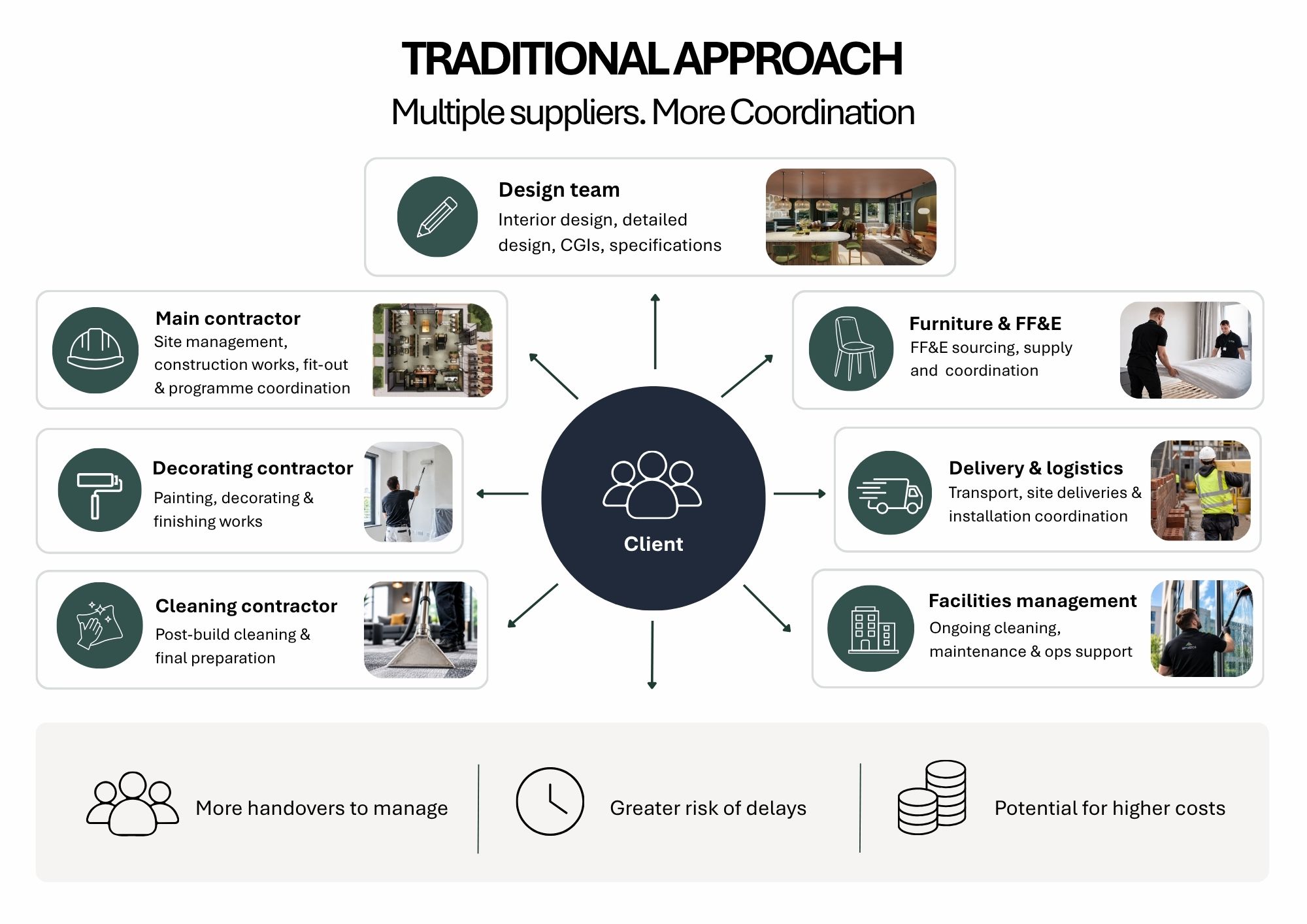
Every time responsibility moves from one company to another, there is another handover to manage. Information needs to be communicated, specifications need to remain consistent and everyone needs to understand what has happened before and what needs to happen next.

The designer may have one point of contact, the fit-out contractor another, while furniture and equipment are being sourced separately. Cleaning, decorating and other facilities services may then be coordinated by another team again.

If those teams are working independently, the client or main contractor can end up becoming the link between all of them.

And when something changes in one area of the project, that information needs to reach everyone it affects.

IP, TSS, Ametros Group Brochure'

How Project Delays Affect the Wider Programme

Delays are sometimes unavoidable on development projects. The problem is that a delay in one area rarely affects just one team.

If an area isn’t ready when expected, the fit-out programme may need to move. That can affect planned furniture deliveries, installation dates, cleaning and decorating works and, ultimately, the handover date.

When each of those services is being managed by a different company, reorganising the programme can mean coordinating several contractors and suppliers individually – all with their own schedules and commitments.

This is where having different services working together can be particularly useful.

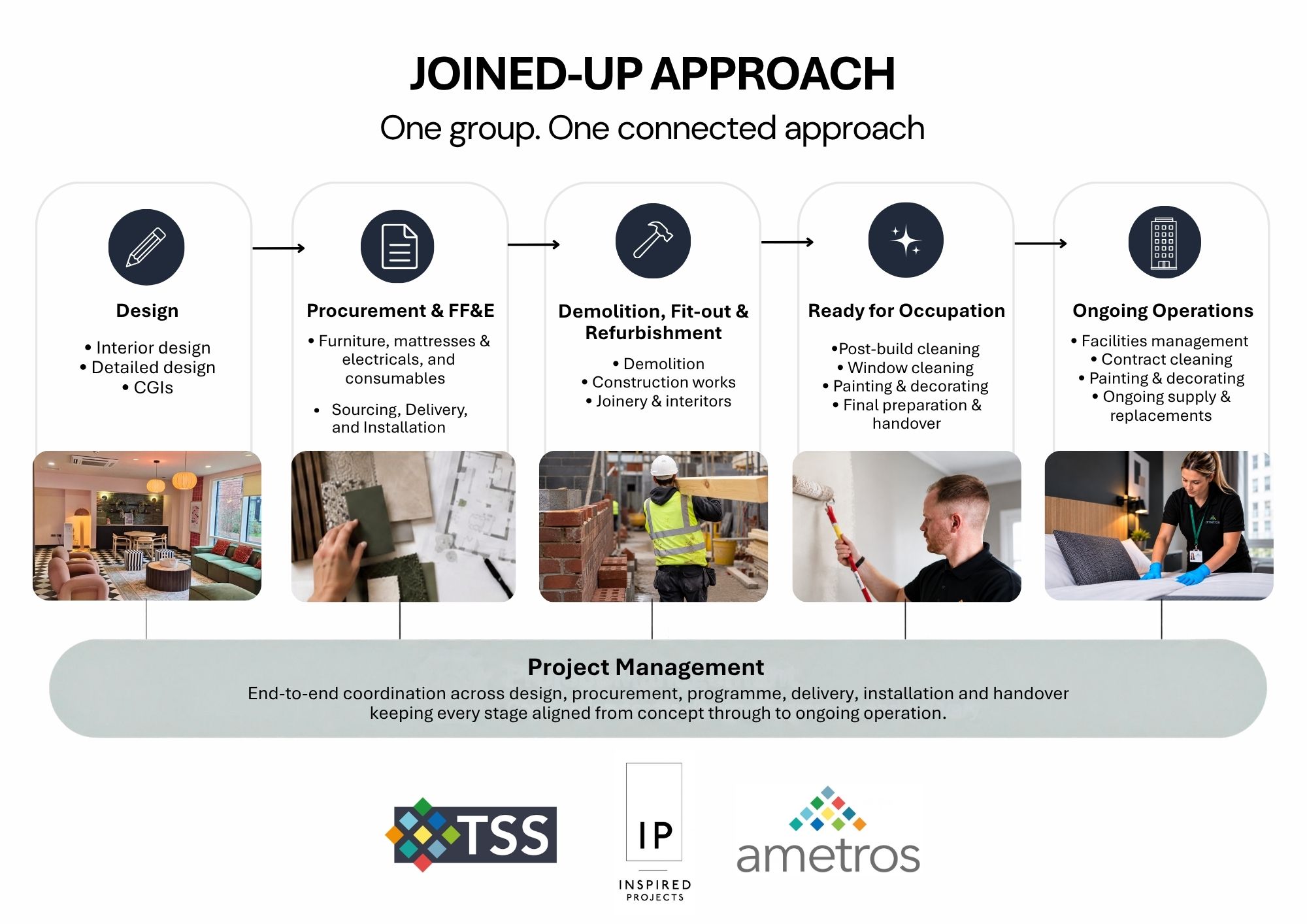
Across Inspired Projects, TSS and Ametros, our teams can communicate changes across design, fit-out, procurement, deliveries, cleaning, painting & decorating and facilities management, helping to coordinate the next stages when dates move.

It doesn’t mean delays won’t happen, but it can make the knock-on effects easier to manage. Instead of each stage being treated in isolation, the teams can look at the wider programme together and respond to what’s actually happening on site.

IP, TSS, Ametros Group Brochure'

Planning for a Smooth Project Handover

There can be a big difference between construction being complete and a building actually being ready for its residents, guests or occupiers.

Furniture may still need to be delivered or positioned. Snagging may need completing. Packaging and construction dust need removing. Areas may require final decorating or cleaning before they can be handed over.

These final stages can sometimes be treated separately from the main programme, despite being an important part of getting the development operational.

Planning for them earlier can help create a smoother transition from construction and fit-out to handover – and from handover into the ongoing operation of the building.

Ametros cleaning

Our group has developed to provide specialist support across the project and building lifecycle, with each business bringing its own expertise.

Inspired Projects, TSS and Ametros can work independently or together, depending on the requirements of the project. This gives clients the flexibility to bring design, fit-out, procurement, cleaning, painting & decorating and facilities management together through businesses that already work closely with one another.

The approach can support projects across PBSA, Build to Rent, residential, hospitality and commercial sectors, from the initial design and delivery stages through to occupation and the ongoing operation of the building.

One group, multiple areas of expertise, with the flexibility to support as much, or as little of the project and building lifecycle as required.

Inspired Projects

Inspired Projects supports projects from design through to delivery, providing interior and detailed design, CGIs, FF&E, bespoke joinery, demolition, refurbishment, fit-out and project management. Bringing design and delivery together allows buildability, budget, specification and programme to be considered throughout, helping maintain the original design intent through to completion.


TSS – The Student Shed

TSS provides procurement, supply and delivery support across the project and ongoing operation of a building. From furniture and bulk mattress orders to replacement electricals, linen, cleaning products, paint and everyday consumables, TSS can source and supply products at scale. The team can also coordinate delivery and installation, arrange the removal and responsible disposal of old mattresses and appliances, and provide linen supply and laundry hire – giving clients one point of contact for a wide range of procurement and operational requirements.


Ametros Facilities Management

Ametros provides cleaning, painting & decorating and facilities management services, supporting buildings from the final stages of a project through to their ongoing operation. Services include post-build cleans, window cleaning, ongoing contract cleaning and painting & decorating, helping prepare developments for occupation and providing continued support once the building is operational.


One Partner

No two developments are the same, and unexpected changes will always be part of delivering and operating buildings.

Having specialist teams that already understand how each part connects can make those changes easier to manage, and allow clients to bring in the support they need, when they need it.

Because the goal isn’t simply to complete a project. It’s to create a building that is ready to use, operate and maintain for the long term.
If you’ve got a project in mind, get in touch to discuss how our group can support your business.

Get in Touch

More News